

The window for a call is hours, not days
When a customer picks up the phone to call a service business, the intent is usually fresh and the comparison is usually live. They are not researching for next quarter. They have a leak under the sink, a broken garage door, a quote needed before the weekend. If the phone rings out and nothing follows, the next company on the Google results page gets the easier conversation.
The background numbers are in the first-click leakage guide: 62% of inbound calls go unanswered in home services, and 85% of voicemail-reached callers never call back. Most of those lost calls do not come back as voicemails to triage later. They come back as a competitor's booking.

How a text-back actually works
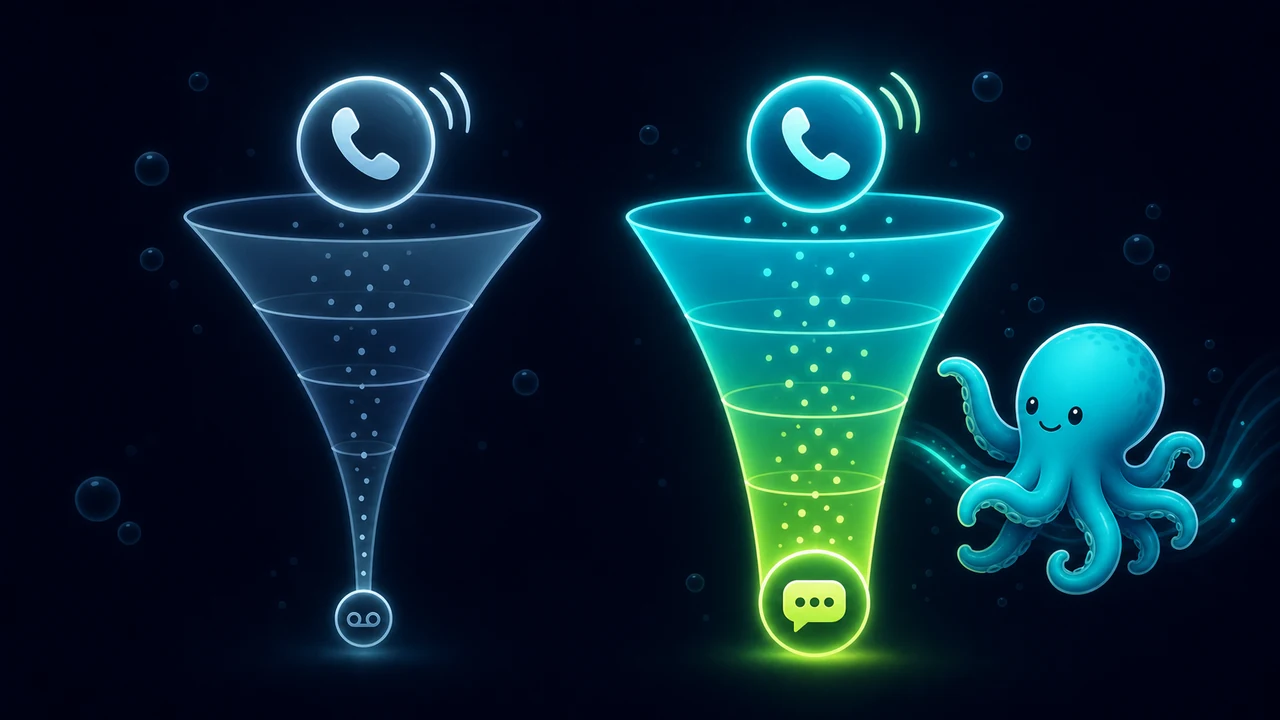
The mechanic is simple. An inbound call rings out, hits voicemail, or is rejected. Within 30 to 60 seconds, an automatic SMS fires from your business number to the caller's mobile. It identifies the business, acknowledges the missed call, and opens a text conversation. The owner gets an alert. The customer can reply. The conversation continues by text until someone is free to call back or book the job.
A useful setup does more than send one message. It tags the missed call inside one inbox alongside form fills and chat messages, routes the reply to whoever is on duty, and keeps the enquiry visible until it is closed or marked dead. NextPhone's setup walkthrough covers the standard variations: greeting tone, after-hours messaging, weekday vs weekend routing.
The recovery numbers, with the upper-bound trap labelled
Vendor case studies on missed-call text-back report dramatic numbers. NetPartners' service-business analysis puts SMS response rates at 35-50% when the auto-text fires within 60 seconds, and recovered booking rates between 30% and 60% of unanswered calls.
Treat those as ceiling numbers, not planning numbers. They come from operators with disciplined follow-up, fast human reply on the second touch, and a customer base that already trusts the brand. A more honest planning range for a typical service business installing text-back for the first time is closer to 15-25% of missed calls recovered into booked jobs. That is still a serious lift if you were recovering close to zero before, but it is not "60% more revenue overnight."
Use the missed enquiry calculator with a conservative recovery rate before scoping the install. If the modelled value is small (low call volume, low average job value, already-decent live-pickup rate), spend the build budget on something else.
Where text-back earns its place (and where it does not)
Three signals say "install this first."
High inbound call volume relative to the team. If the owner is on jobs all day and the phone rings 20 times a week, the lift is mechanical.
Currently zero or near-zero voicemail callback discipline. The text-back is replacing nothing, so even a modest reply rate is a clean win.
After-hours and overflow traffic. Calls arriving Saturday afternoon or Tuesday at 7pm are not getting picked up. A polite "we will be back on the phone tomorrow 8am, text here and Steve will pick it up first thing" recovers most of that bucket.
Two signals say "wait or skip."
A live receptionist who already answers most calls. The text-back fires only on the small misses. Lift exists but is small; pick a different leak.
The auto-text would become a worse customer experience than no reply. If the text fires, the customer replies in 90 seconds, and nobody on the team sees the reply for 8 hours, the missed-call experience has been made worse, not better. Build the human follow-up route first, then turn on text-back.
The boring compliance you cannot skip
Missed-call text-back is one of the safer SMS use cases because the caller initiated the contact. The legal frameworks generally treat that as an established business relationship. "Generally" does not mean "always," and the rules tightened materially in 2025.
US: TCPA and 10DLC. Since February 2025, all major US carriers block SMS from unregistered 10DLC numbers. Registration sits with your SMS provider through The Campaign Registry; brand approval takes one to three business days, campaign approval two to seven. The auto-text itself must include an opt-out path. FCC rules that took effect April 11, 2025 require businesses to accept opt-out via any reasonable method (STOP, unsubscribe, cancel, email, phone, web form) and honor it within 10 business days. TCPA penalties are $500 per non-compliant message, $1,500 if willful, routinely enforced through class actions in the tens of millions.
UK/EU: PECR and GDPR. Transactional replies to an inbound caller are generally lawful under PECR's "soft opt-in" and the established-business-relationship logic. Adding marketing content to the same message (a promo code, a discount offer) usually requires separate consent. The Data (Use and Access) Act 2025 lifted maximum PECR fines from £500,000 to £17.5m or 4% of global turnover. The reply must include an opt-out path and your business name.
None of this is legal advice. Confirm the current rules with your SMS provider and, if you operate at any scale, a regulator-aware lawyer in your jurisdiction. The general posture: keep the auto-text transactional, identify the business, offer the opt-out, do not bolt marketing onto it.
A short template that does not read as spam
Four parts. Identification, acknowledgement, next step, opt-out.
Working-hours version. "Hi, this is Steve at Northpoint Roofing. Sorry I missed your call. What can I help with? Reply STOP to opt out."
After-hours version. "Hi, this is the out-of-hours line for Northpoint Roofing. The team is back on the phones tomorrow 8am. Text here and I will pick it up first thing. Reply STOP to opt out."
What to avoid. "Hi! We noticed you tried to reach us! Click here for $50 off your next service! Limited time only!" That is marketing in transactional clothing. It will spike the opt-out rate, attract spam-filter penalties, and create the compliance exposure you were trying to avoid. The auto-text exists to keep the conversation alive, not to sell.
What to measure
Four numbers tell you whether the text-back is working.
Reply rate. Replies as a percentage of missed calls that received a text-back. Healthy for a service business: 20-35%. Below 10% means either the message reads wrong, the customer base does not text, or your timing is off.
Time to second touch. From the customer's reply to a human (or sequenced) response. Target: minutes, not hours. The auto-text is only useful if a human picks up the conversation while intent is still fresh.
Recovered booking rate. Booked jobs sourced from text-back conversations as a percentage of missed calls. This is the number to put in the calculator and the audit.
Opt-out rate. Under 2% is healthy. Above 5% means the auto-text reads as marketing or arrives at the wrong time. Rewrite the message before you blame the customer.
Where it fits in the rest of the system
Text-back is a single patch on the intake stage of the leak map. It does not replace the follow-up system, the review ask, or the reactivation loop. It fixes the moment of the missed call so the rest of the system has something to work with.
If missed calls are the obvious leak, the system audit exists to confirm it and to scope the recovery route. The services pages show what a configured missed-call route includes, and pricing shows where it sits commercially.